

Perhaps the first type of narrator a historical novelist might reach for is the bread-and-butter omniscient third person. Advantages: the ability to swoop down into the points of view of different characters, so that events may be illuminated from different angles. Also, the ability to zoom out, narrate the bigger picture, the consequences that are not always perceived on the ground, or in the immediate. Caveat: in the third person, the writer might fall too easily into the historian’s voice, the kind of writing one is more likely to encounter in non-fiction: this happened and then this happened, with a bit of dialogue thrown in. The third person gives a veneer of objectivity, and history is anything but.
That is not to say that historical fiction in the third person can’t be great (Hilary Mantel immediately comes to mind, though she keeps a vice-like grip on her main character in the Cromwell books and never really looks up from his perspective), but many have leaned into first-person narrators to bring the past to life. Advantages: an eye-witness account, the vividness of a subjective gaze, a living voice that echoes through the centuries. Caveat: can we really believe that someone in the past wrote like that, thought like that? Then again, a greater or lesser degree of suspension of disbelief is par for the course when reading any kind of fiction. It’s just that great artists make you forget about the artifice.
There is a particularly strong tradition, perhaps since Robert Graves’s I, Claudius (originally published in 1934) of historical fiction set in the classical world and written in the first person. You can trace that tradition through to Marguerite Yourcenar’s Memoirs of Hadrian, many of Mary Renault’s novels set in Ancient Greece, right up to more recent bestsellers such as Annabel Lyon’s excellent The Golden Mean, narrated by Aristotle as he tutors Alexander the Great (and currently being adapted as a Netflix series by Jacob Tierney), and its companion The Sweet Girl, about Aristotle’s daughter.
As I’ve recently been writing historical fiction set in the hellenistic period and narrated in the first person, I’ve enjoyed three very different books, set in very different places and time periods, but that were published in recent years and all share in this same mode: a first-person narrator, looking back on their life.
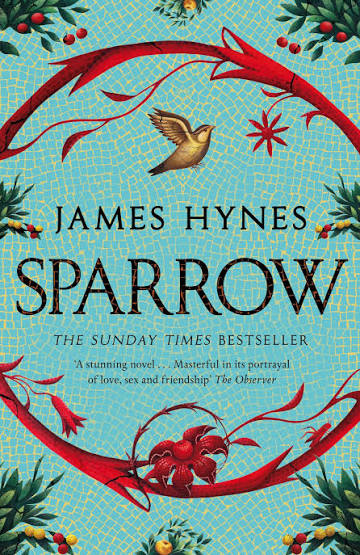
Seemingly out of nowhere, the American writer and Creative Writing professor James Hynes, whose back list includes a novel about the IRA and a dark comedy about a depressed temp writer in Texas, began writing about the distant past. Sparrow is about a slave boy who grows up in a brothel in Cartago Nova, a far-flung town in Spain in the dying days of the Roman Empire. Yes, there is horrific abuse of exactly the kind you expect, and yet the smooth prose and vivid present tense, keeps us grounded in the perspective of this smart boy, gradually losing his innocence. It’s a book about quiet and not so quiet rebellion, about survival, and about found family. While it can be a bit claustrophobic at times, that is also fitting for the kind of isolated life the narrator is living; his entire universe is the tavern where he lives and works.
I found the sequel, Peacock, which unfortunately appears to have gained less attention, even better. Our nameless main character–boy, Sparrow, Ganymede, peacock–is castrated, trained in the arts of physical love, and sold off to a powerful governor to be his play thing. From his guilded cage, he gains agency by learning to read, spying on his master, and becoming embroiled–at a distance–in the palace intrigues of Rome. Historical fiction at its finest, and also a breath of fresh air in the genre.
Ferdia Lennon’s Glorious Exploits is another unexpected and welcome addition to the genre. The somewhat whacky premise tells you everything you need to be hooked: in the midst of the Peloponesian War, two unemployed potters in Syracuse, on the island of Sicily, decide to stage Euripides’ latest play by using Athenian prisoners of war as their actors. Oh, and it’s written in contemporary Irish vernacular. It should’t work. It works, wonderfully. It’s funny and sad, bitter and sweet. It’s a book about friendship and love, about creating art and building community from the ashes of war. The scene in which our foolish narrator, having come into some money, goes on a shopping spree at the market and buys himself crocodile-skin shoes (he calls them crocs) and a lightning-blue tunic, is unforgettable.
And finally, there’s the writer who’s fast becoming the master fiction writer of ancient Rome: Robert Harris. He tackled the life of Cicero in three novels, narrated by Cicero’s devoted, lifelong secretary Tiro (a real historical figure who did in fact write a now lost biography of his master, and also invented a short-hand notetaking system that was still used centuries after his death). These were essentially political/legal thrillers with togas. Now, Harris picks up the narrative of Rome’s passage from Republic to Empire with Agrippa, a fictionalized memoir of Augustus’ right-hand man–a capable general, builder, and statesman who propped up Augustus during much of his reign.
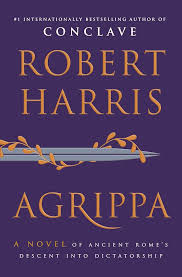
With serviceable prose, Harris moves at a fast gallop through Agrippa’s life and lifelong frienship with Augustus–a relationship that remakes the world as the duo conquer enemies (real and invented) one by one, so that only one man can stand unchallenged at the top. It’s a frightening, relevant study in dictatorship, and the making of an autocrat. The tension in the novel emerges from the question of loyalty: how far Agrippa is ready to go for his friend and patron, as Augustus’s demands become greater and greater. In the end, Agrippa recognizes that he practically has to erase himself and his achievements to the service of his manipulative, egotistical master. Harris’s adds the (likely) fictional flourish, but deeply novelistic irony, that Agrippa was actually Julius Caesar’s biological son, which would’ve given him a much more legitimate claim to power.
I was interested to note how much Harris eschews the usual toolbox of the historical novelist, who are often lauded when they’re able to make you “feel as if you were there.” Harris is disinterested in the sights, smells, and tactility of Ancient Rome; scene-setting is perfunctory; many characters go without physical descriptions. Dialogue is kept to a minimum, and introduced with speedy dashes instead of quotation marks and speech tags. The spare, workaday prose befits our narrator: an effective, straightforward military man looking back on his life with a clear eye and no desire for embroidery. The result is a fast and compelling read, a thought-provoking character study of these two statesmen, one who needed the light on him at all times, and the other who had to obliterate himself in the name of–what exactly? Let’s call it peace.
Leave a Reply